Enemy of love, Math is not lonely, Math as civilization
Weekly I/O #131: Attachment is Enemy of Love, Collaborative Math Engineering, Math as Civilization, Math as Art, Mantra for Running Companies
Following up on Rumination #14, I built a tool for Mac that understands your screen and helps you at every step of building and learning in real time.
It’s early but there’s something magical already! A non-technical user set up Claude Code and started building for the first time because of the tool.
Download it here: https://mouseover.ai/download
To handle usage, you can use this access code:
weeklyio
Hey friends,
Back to Weekly, one input this week about love, three inputs about math, and one about running companies.
Happy learning!
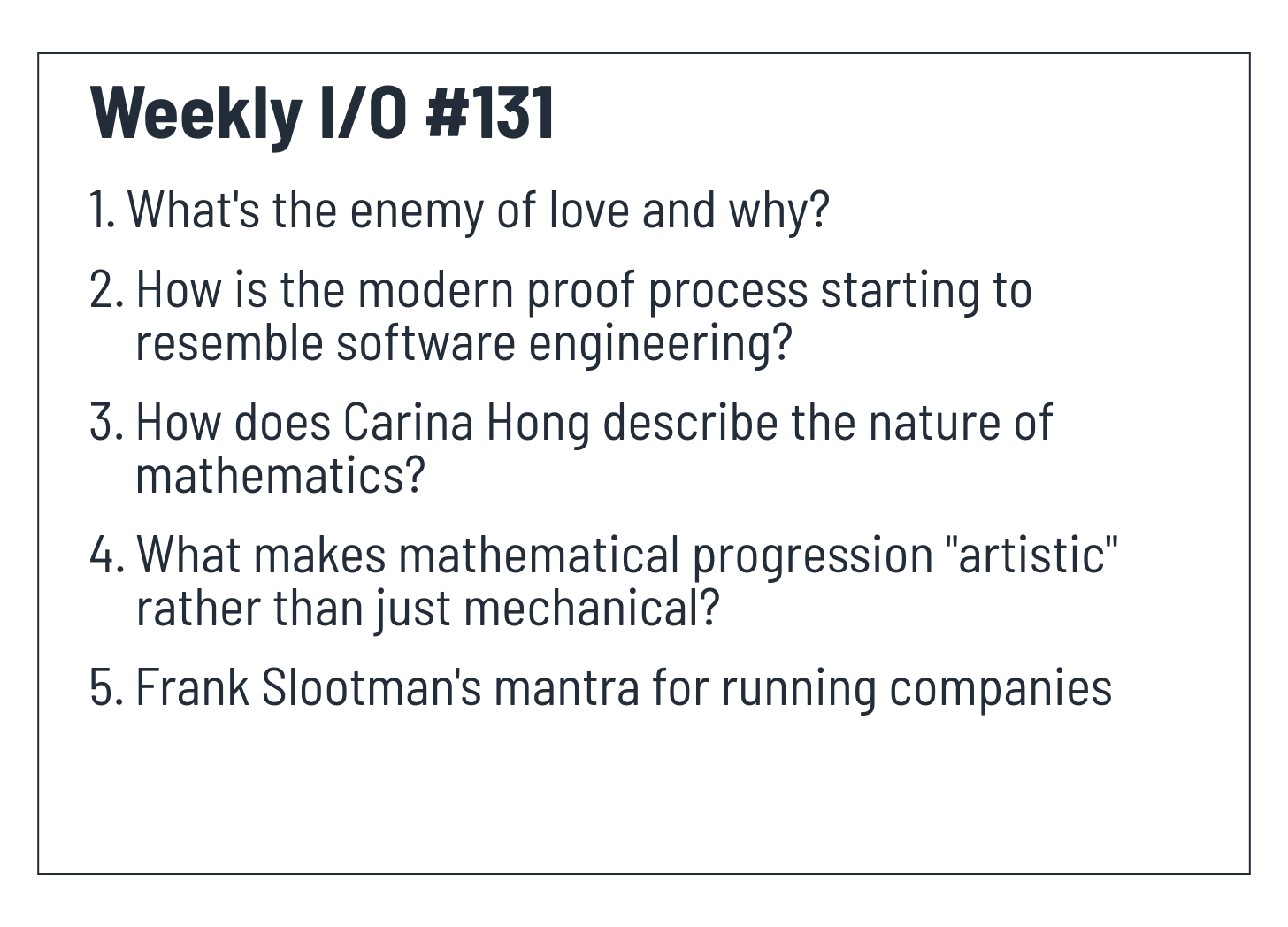
Help you absorb better with Forward Testing Effects
Input
1. The near enemy of love is attachment. True love allows, honors, and appreciates. Attachment grasps, demands, needs, and aims to possess.
Book: Atlas of the Heart
I believe originally from Jack Kornfield:
“The near enemy of love is attachment. Attachment masquerades as love. It says, “I will love this person (because I need something from them).” Or, “I’ll love you if you’ll love me back. I’ll love you, but only if you will be the way I want.”
This isn’t the fullness of love. Instead there is attachment-there is clinging and fear. True love allows, honors, and appreciates; attachment grasps, demands, needs, and aims to possess.”
This reminds me of the concept of Clean Love from The Ethical Slut:
Clean love is love without expectations. Washing your love clean doesn’t require advanced spirituality or weekly psychoanalysis.
You’ll probably never let go of every single attachment—at least we’ve never managed it. But maybe you can let go just for an instant: your history, worries, frets, and yearnings will still be there to come back to when you need them. Just for now, take a look at the wonderful person who is standing right in front of you.
Again, I think it all ties back to the best way to get a good spouse is to deserve one. To love more, to love without expectation, to love just for the sake of it.
2. The paradigm of mathematical proof is shifting from solitary genius to collaborative software engineering. AI and formalization are turning proofs into blueprints that can be crowdsourced.
Podcast: A 4-hour Interview with Carina Hong: AI for Math, Lean, Proofs from The Book, and Intuition
The romantic image of math is a lonely genius solving a centuries-old problem at a chalkboard for 10 years.
But today, that image is quietly being replaced.
Modern proofs are increasingly broken down into massive, formalized projects. Terence Tao and Alex Kontorovich have started decomposing big theorems into “blueprints” that cut the proof into hundreds of smaller, well-defined tasks that anyone in the world can pick up and contribute to.
Carina Hong says proof now resembles collaborative software engineering more than solitary insight.
This is powered by formal verification languages like Lean. Through the Curry-Howard correspondence, every mathematical proof can be mapped to a computer program.
Furthermore, AI approaches math proofs through a completely different philosophy. In a recent Putnam-style problem, a human solved a geometry question with a single elegant drawing. The AI produced thousands of lines of brute-force enumeration. Same answer, but completely different method.
Therefore, the future role of the mathematician will likely rely less on mechanical labor and more on elite intuition about which conjectures to pursue and where to direct the AI’s computing power.
3. Mathematics is a civilization humans built upward from a small set of shared axioms. Like a contract, mathematicians agree on what feels “natural” enough to take for granted, and then construct everything else on top.
Podcast: A 4-hour Interview with Carina Hong: AI for Math, Lean, Proofs from The Book, and Intuition
Carina Hong describes math as a language of structure.
That feels more accurate than saying math is about numbers. A lot of higher math is not about calculating faster. It is about building a world carefully.
Mathematicians begin with axioms. These are the starting assumptions everyone agrees to accept. From there, they define objects, notice patterns, form conjectures, and prove theorems.
And the deeper image she uses is civilization.
Mathematicians sign a kind of contract. They agree on which axioms count as fundamentally true. Some try to use the fewest possible axioms. Others look for the most interesting combination. Either way, the foundation is chosen, not discovered.
Then a theorem becomes a road, tool, or building block for future work. From that foundation, the civilization is built upward.
You observe examples. You notice a pattern. You guess what the next theorem “should” be. Then you prove it. This upward construction is what makes math feel less like calculation and more like art.
4. The essence of math lies in the artistic progression from observation to theoretical construction. Aesthetics and beauty are diagnostic tools for evaluating mathematical truth.
Podcast: A 4-hour Interview with Carina Hong: AI for Math, Lean, Proofs from The Book, and Intuition
We oftentimes picture math as right or wrong. But Mathematicians have a third axis: beauty.
Aesthetics play a central role. Even if a proof is logically correct, mathematicians will debate whether it is “beautiful” or “natural.”
Beauty often signals that two seemingly distinct fields have found a deep, hidden connection. (like the Modularity Theorem as a famous example of elegance. It links algebraic equations with the geometry of elliptic curves.)
This shared artistic intuition acts as a guiding force. Because mathematicians share similar training, they develop a profound sense of what a “natural” progression should look like.
This pairs with Buckminster Fuller’s idea that when a finished solution isn’t beautiful, something is still wrong.
5. Frank Slootman’s rules for running companies: increase the tempo, raise the standards, narrow the focus.
Article: Performance Culture by Frank Slootman
Rewatching The Devil Wears Prada reminds me of this essay from Frank Slootman.
These three things are especially important because they are against an organization’s natural inertia.
You can always finish a project if you can keep extending the deadline or lowering the standard. That’s an organization’s natural tendency. But a leader’s responsibility is to drive for excellence by combating that inertia.
Also related: CEOs Don’t Steer.
Links
Here’s a list of things I enjoyed learning/relearning this week:
Recap
Try answering these five simple questions to review and reinforce what you’ve learned:
Thanks for reading!
One small favor: please share which input you found the most helpful or intriguing! Just comment on Substack with a number!
It only takes 6 seconds to like and comment, while writing each newsletter takes me 6 hours 🫶
And as always, feel free to send me any interesting ideas you came across recently!
Looking forward to learning from you,
Cheng-Wei
If you enjoy reading Weekly I/O, please share it with others who might also like it. You’ll have a chance to get a free paid subscription for one, three, or six months.
Subscribe to Cheng-Wei’s Update | Subscribe to 程維的中文更新 | Subscribe to Weekly I/O | Facebook | Twitter


