

Beautiful solutions, Make more things, Alien tech trees
Weekly I/O #130: Beautiful Solutions, Equal Odds Rule, Alien Tech Trees, Slow Verification Loops, Moving Bottlenecks

Hey friends,
Four inputs this week come from Michael Nielsen’s conversation with Dwarkesh Patel on how science actually progresses. And one Buckminster Fuller quote I keep returning to.
Happy learning!
Help you absorb better with Forward Testing Effects
Input
1. “When I’m working on a problem, I never think about beauty. I think only how to solve the problem. But when I have finished, if the solution is not beautiful, I know it is wrong.” — Richard Buckminster Fuller
Quote
I learned this from Yvon Chouinard, founder of Patagonia, in his book Let My People Go Surfing.
Buckminster Fuller, the architect and systems thinker behind the geodesic dome, never chased elegance for its own sake.
He focused entirely on solving the problem. But he treated beauty as a diagnostic. If the finished solution felt clunky, something was still wrong.
Why would beauty signal correctness? One reason is Occam’s razor. Between two competing explanations, the simpler one is preferred. A beautiful solution oftentimes strips away unnecessary complexity and captures only what matters. The clutter is gone, and what remains feels inevitable.
This also reminds me of what David Hilbert said about the importance of scientific work:
“One can measure the importance of a scientific work by the number of earlier publications rendered superfluous by it.”
2. The Equal Odds Rule: The likelihood of any single work becoming a major hit stays roughly the same across a creator’s career. Most great creatives become great not by cracking a secret formula, but simply by producing a lot.
Podcast: Michael Nielsen – How science actually progresses
Psychologist Dean Keith Simonton proposed the equal odds rule: across a creator’s lifetime, the probability that any individual work becomes a major hit stays roughly the same.
What really determines which era they’re most productive in is how much they’re publishing. Any given thing has equal odds of being extremely important.
Of course, there are exceptions. Gödel published almost nothing, yet rewrote the foundations of logic. However, Michael Nielsen believes you need a very good reason not to follow the Equal Odds Rule.
The most successful creatives, Shakespeare, Mozart, and Picasso, did not crack a secret formula. They simply produced an enormous volume of work and let the math do its job.
Nielsen observed that brilliant people who fail to produce anything are often allergic to public judgment. They wait endlessly for the “great project” that will make them famous.
The waiting becomes the work. Nothing ever ships. This echoes Quantity Predicts Quality.
3. The science tech tree is far bigger and more branched than we realize. Most of it will never be explored. An alien civilization’s technology stack would likely be radically different from ours, shaped by different senses and environments.
Podcast: Michael Nielsen – How science actually progresses
There is a popular picture of science as a single linear “tech tree.” First electricity. Then computers. Then AI. As if every advanced civilization eventually walks the same path in roughly the same order.
However, this picture can be too narrow.
The actual tech tree is enormous and densely branched. The path we take is highly contingent on our environment and sensory biases. In other words, scientific progress can be path-dependent and far from inevitable.
For example, the foundations of computer science were laid in the 1930s. But almost a century later, we are still discovering profound and foundational ideas inside those foundations, such as public-key cryptography, decentralized ledgers, and quantum computing. One small branch keeps unfolding into more branches.
Therefore, an alien civilization might have a completely different tech stack. Perhaps they master biology or complex systems long before discovering radio.
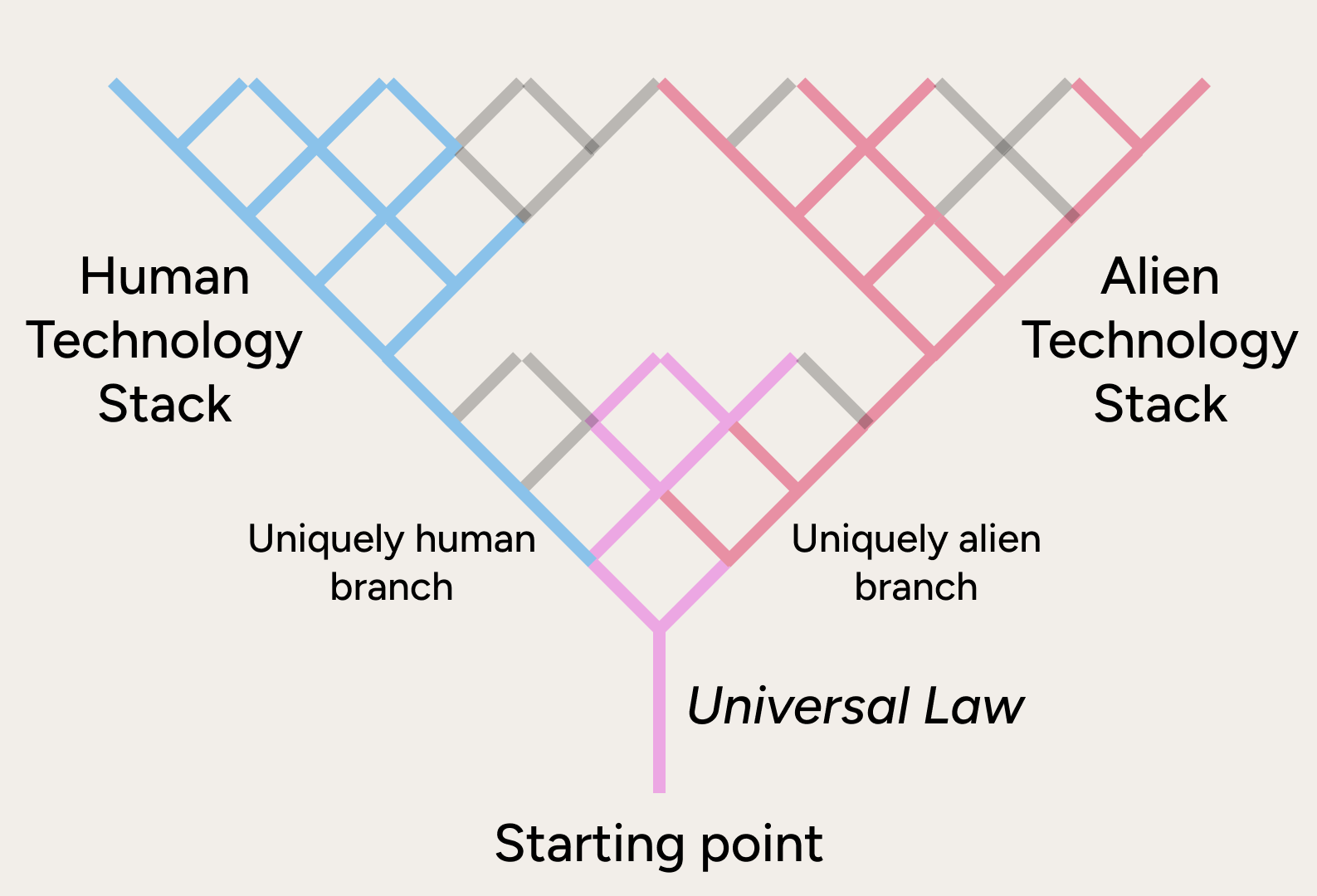
If this assumption is true, the corollary is that we have significant agency over the future. Because most of the tech tree will never be explored, we aren’t actually following a map. Instead, we are choosing which branches to grow and which ones to cut off.
This optimistic view on human agency feels close to Definite Optimism.
4. Good ideas can wait a very long time for clean proof. In science, verification loops are often slow, noisy, and sometimes hostile to the truth.
Podcast: Michael Nielsen – How science actually progresses
We tend to imagine that experiments quickly confirm or kill theories. Unfortunately, reality is much messier.
Good ideas can wait a very long time for clean proof.
