

Become Me more and more, Drama Triangle, PMF Engine
Weekly I/O #129: Become Me More and More, Drama Triangle, PMF Survey, Elaborative Encoding, Constructive Confrontation

Hey friends,
I sent Useful Definitions for Life last week. It’s live now for paid subscribers first, and free subscribers will get access very soon.
This week is about truth, courage, memory, and product. Happy learning!
Help you absorb better with Forward Testing Effects
Input
1. “I am Me, and I hope to become Me more and more. That is surely the goal of all our struggles.” — Paula Modersohn-Becker
Quote
From German Expressionist painter Paula Modersohn-Becker:
And now, I don’t even know how I should sign my name. I’m not Modersohn and I’m not Paula Becker anymore either. I am Me, and I hope to become Me more and more. That is surely the goal of all our struggles.
She wrote these words in 1906 while in Paris, having temporarily left her husband to pursue an artistic independence that rejected both her maiden name (Becker) and her married name (Modersohn) as external labels.
We perhaps shouldn’t view “self” as a destination we reach. It’s more of a process of uncovering that requires the courage to be “unlabeled“.
This reminds me of Nietzsche’s “the end of a melody is not its goal“. Also, “We should stop asking about the meaning of life and think of ourselves as those being questioned”.
2. The Drama Triangle: If you cannot face another person directly, you will drag a third person in and call it “process”. The three roles of Victim, Persecutor, and Rescuer rotate endlessly and rot companies from the inside.
Paper: Fairy Tales and Script Drama Analysis
Have you ever seen someone bring a complaint to a manager instead of talking to the person directly?
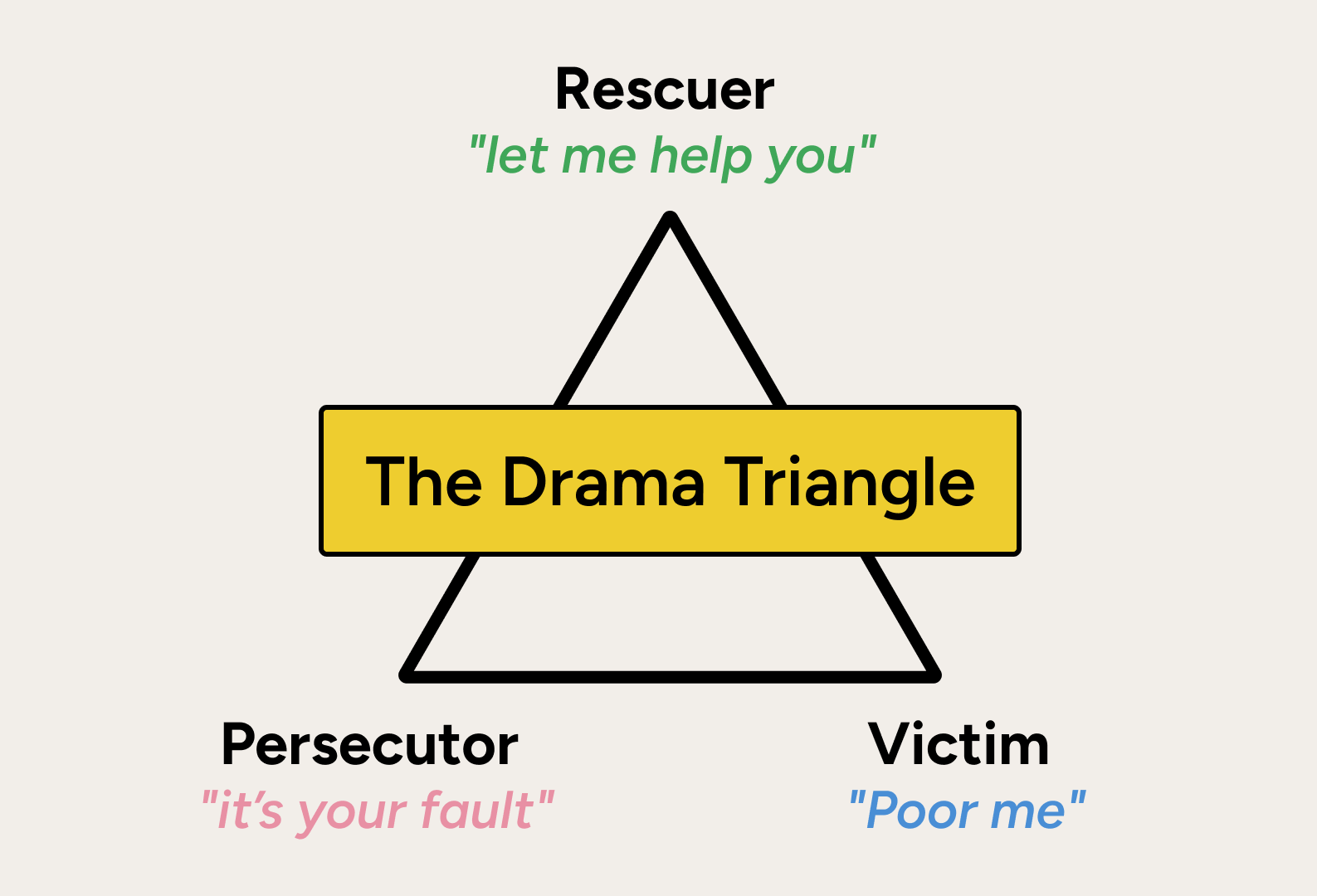
In 1968, psychiatrist Stephen Karpman published a model called the Drama Triangle. It describes three roles people unconsciously rotate through: the Victim (”poor me”), the Persecutor (”it’s your fault”), and the Rescuer (”let me help you”).
The roles are not fixed. They shift constantly. A Rescuer who feels unappreciated flips to Persecutor. A Victim who accumulates enough resentment also becomes the Persecutor. No matter where you start on the triangle, everyone ends up feeling like a victim.
In organizations, this becomes triangulation. Person A has an issue with Person B, so A goes to a manager instead of talking to B directly. The manager now holds anxiety that belongs to A and B.
And the worst part: the triangulation gets legitimized. It becomes “process.”
Anonymous feedback tools, mediation protocols, and escalation frameworks absorb the anxiety that two adults could resolve in a 15-minute conversation. Once the process exists, going direct is seen as aggressive. The triangle has eaten the culture.
David Emerald’s Empowerment Dynamic offers an easy antidote: speak directly!
Therefore, the Victim becomes a Creator who asks, “What do I want?” The Persecutor becomes a Challenger who holds others accountable with care. And the Rescuer becomes a Coach who asks, “Have you spoken to them about this?”
3. Define Product-market fit beyond just feelings: Ask users how they would feel if your product disappeared. If 40% say “very disappointed,” you have found it. This way, you define it as a number you can hillclimb.
Article: How Superhuman Built an Engine to Find Product-Market Fit
Marc Andreessen famously defined Product-Market Fit(PMF):
“You can always feel when product-market fit is not happening. The customers aren’t quite getting value out of the product, word of mouth isn’t spreading, usage isn’t growing that fast, press reviews are kind of ‘blah,’ the sales cycle takes too long, and lots of deals never close.
And you can always feel product-market fit when it is happening. The customers are buying the product just as fast as you can make it — or usage is growing just as fast as you can add more servers. Money from customers is piling up in your company checking account. You’re hiring sales and customer support staff as fast as you can. Reporters are calling because they’ve heard about your hot new thing and they want to talk to you about it. You start getting entrepreneur of the year awards from Harvard Business School. Investment bankers are staking out your house.”
Rahul Vohra turned it into a metric by asking users: “How would you feel if you could no longer use this product?” with a PMF threshold of 40% “very disappointed.”
Superhuman started at 22%. But his first move wasn’t to build anything. He segmented users to find which personas appeared most in the “very disappointed” group. By narrowing the target audience, the score jumped to 33% without a single product change.
