


Hey friends,
I launched a learning app for early access! You can use the code 10x to get access this week.
Download on iOS: apple.co/4beZmIA
Android and Web: wondering.app
Back to Weekly. The first two inputs this week are about how to be more alive and how to speak more truthfully in public.
The last three come from a learning science paper that gave me a cleaner way to think about what to learn, how to learn it, and how to know whether it worked.
Happy learning!
Help you absorb better with Forward Testing Effects
Input
1. Discovering more joy does not save us from the inevitability of hardship and heartbreak. In fact, we may cry more easily, but we will also laugh more easily. We are more alive, and perhaps that’s the ultimate goal of life: to be more alive.
Book: The Book of Joy
From archbishop and Nobel Peace Prize laureate Desmond Tutu:
Discovering more joy does not, save us from the inevitability of hardship and heartbreak. In fact, we may cry more easily, but we will laugh more easily too. Perhaps we are just more alive. Yet as we discover more joy, we can face suffering in a way that ennobles rather than embitters. We have hardship without becoming hard. We have heartbreaks without being broken.
Joy and hardship are not mutually exclusive. If anything, joy may make us cry more easily. But it also makes us laugh more easily. We become more sensitive to the full spectrum of human experience.
Therefore, the goal of a meaningful life is not to avoid the inevitability of suffering. Instead, it is to develop internal resilience to withstand heartbreak without being broken.
The opposite of dead is to be alive. Perhaps the ultimate goal of life is just to be more alive.
This also reminds me of Leibniz’s Best Possible Worlds, where he tries to answer the question, “Why do tragedies exist if God is omnipotent?”
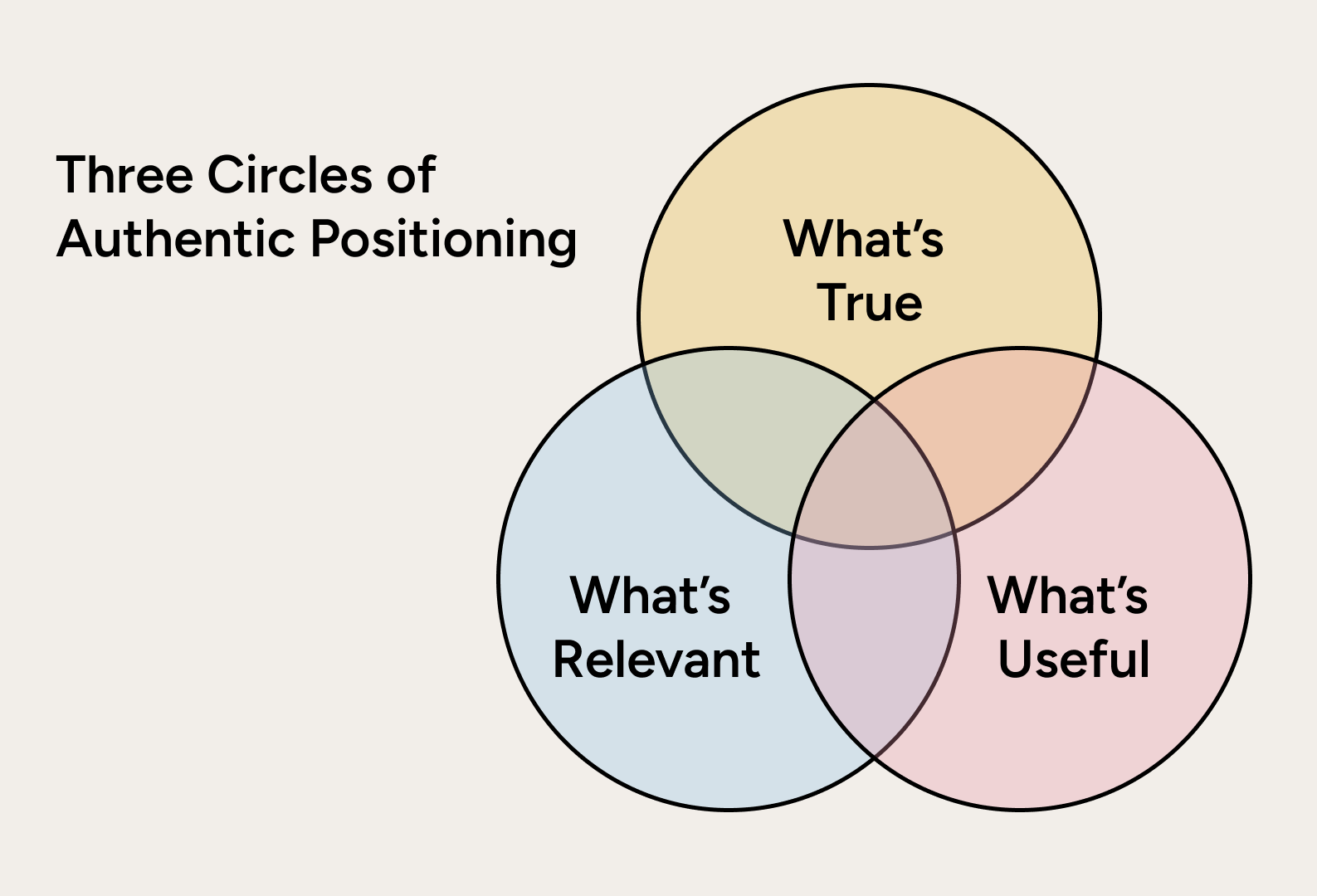
2. Good positioning is not manufacturing a persona. It is selecting and amplifying the three circles of positioning: what is true, relevant, and strategically useful.
Podcast: Helping Founders Go Direct in a New Era of PR & Comms with Lulu Cheng Meservey | Ep. 25 - YouTube
Good positioning shouldn’t be fake packaging. If the message does not match the person, people feel the mismatch.
Positioning stops working the moment it drifts too far from reality.
For example, if a founder is naturally sharp, intense, and technical, you cannot convincingly package them as a warm, fuzzy people-manager. People may not be able to explain why it feels off, but they can feel the mismatch.
That is what I found useful in Lulu Cheng Meservey’s framing. Instead of inventing a character, positioning should focus on compression and amplification. The world cannot absorb the full complexity of a person, so you choose which true parts to make more legible.
She describes a useful filter: your messaging should select and amplify the overlap of three circles: what is true, what is relevant, and what is strategic.
If it is true but irrelevant, nobody cares.
If it is relevant but untrue, it feels manipulative.
If it is true and relevant but not strategically useful, it may get attention without helping the actual mission.
So don’t just say whatever will go viral. The goal is to make the right truths louder.
