

Euphemism treadmill, The Disney language, Opening at 80%
Weekly I/O #127: Euphemism Treadmill, Disney Language, 80 Percent Finish, Gen Z on AI Companions, Joy as Competitive Advantage

Hey friends,
Three inputs come from Disneyland and Steven Pinker. One looks at how Gen Z uses AI companions, and one is a simple thought on joy I want to remember.
Happy learning!
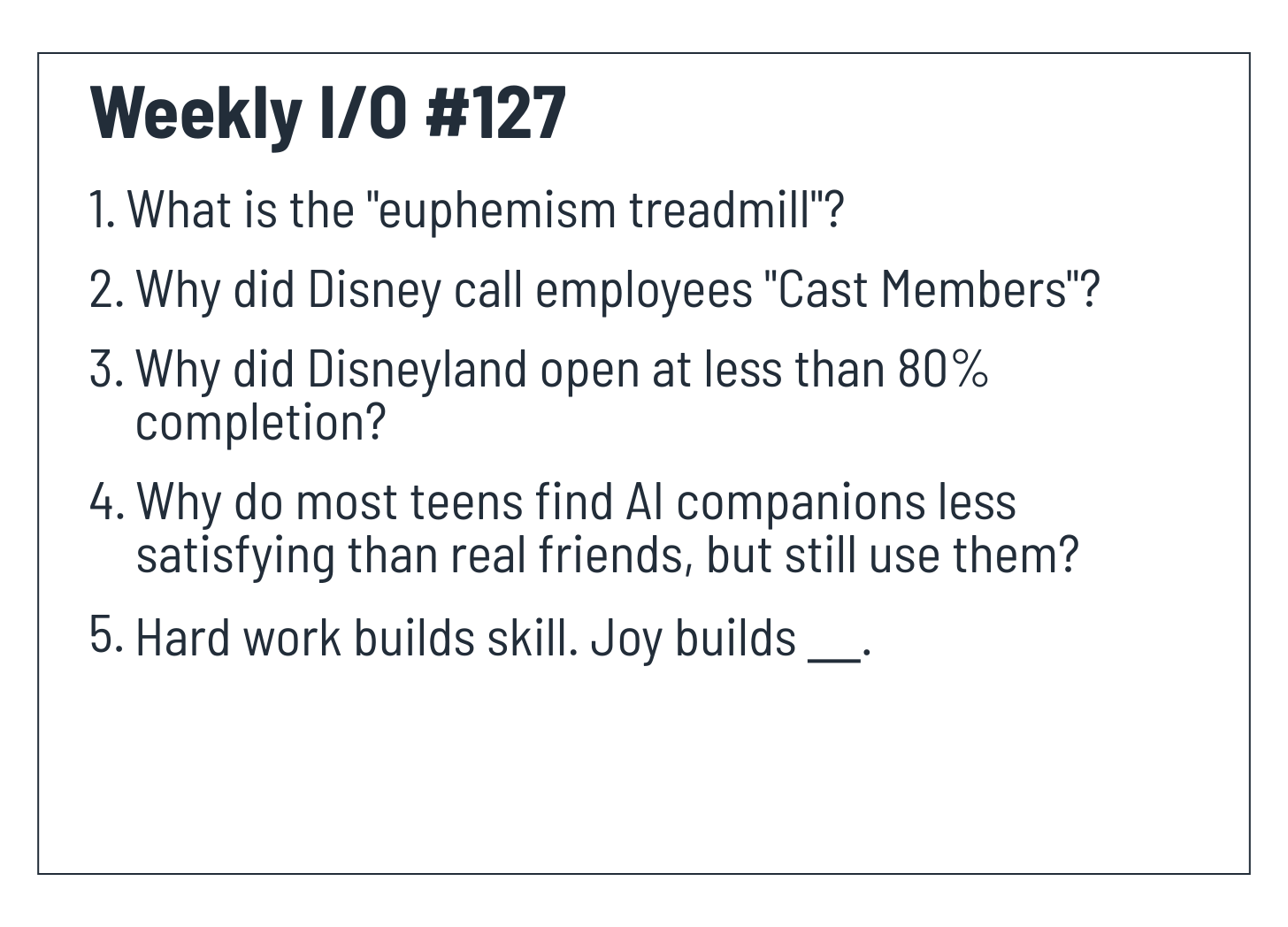
Help you absorb better with Forward Testing Effects
Input
1. The Euphemism Treadmill: Replacing an offensive word with a neutral one doesn’t remove the stigma. Because concepts, not words, drive how people feel, any new term will eventually absorb the same negativity as the one it replaced.
Book: The Blank Slate: The Modern Denial of Human Nature
Why do polite words keep becoming impolite?
Steven Pinker popularized a useful idea: the euphemism treadmill. The pattern: we replace an offensive word with a neutral one, but the new word eventually absorbs the same stigma. So we replace it again.
For example, “Imbecile” was replaced by “retarded,” which was replaced by “mentally challenged,” which was replaced by “intellectually disabled.”
Each term starts clean and ends tainted. The underlying condition hasn’t changed much. But the label constantly changes.
First, we introduce a cleaner term. Then, social stigma “contaminates” it through repeated use. Eventually, that term feels insulting too. Then we create another term and restart the cycle.
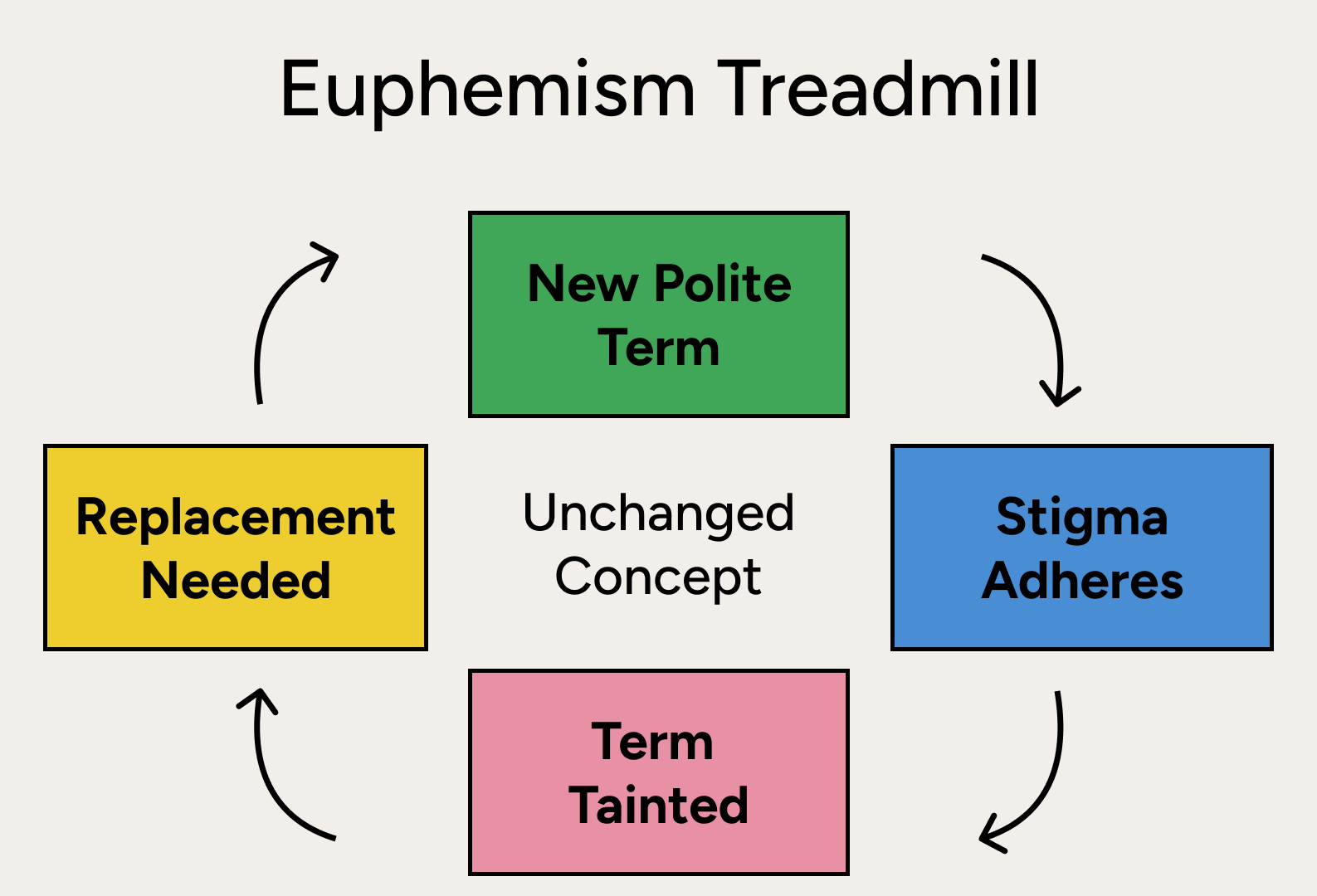
The same happens with “water closet” → “toilet” → “bathroom” → “restroom.” The room is the same. We just keep renaming it.
Pinker argues that concepts, not words, are primary in our minds. In his words
“Give a concept a new name, and the name becomes colored by the concept; the concept does not become freshened by the name.”
Updating language matters because words can reduce unnecessary harm in the short run. But Pinker’s deeper point is still useful: concepts are sticky. If we want better language over the long run, we also need better institutions, better incentives, and better norms.
And again, this is related to our favorite philosopher Wittgenstein‘s two concepts: Family Resemblance and Language Games.
Also relate: replacing the “R-Word” (though I don’t think Steven Pinker actually “coined” the word Euphemism Treadmill)
2. Disney created a theatrical vocabulary for Disneyland: guests not customers, cast members not employees, attractions not rides. The words we use to describe an experience shape how we perceive it.
Book: Disney’s Land: Walt Disney and the Invention of the Amusement Park That Changed the World
When Walt Disney toured existing amusement parks before building Disneyland, he found them disgusting. The employees called paying visitors “marks.”
Disney wanted the opposite. He saw Disneyland as a “three-dimensional film” and refused to hire anyone with amusement park experience. Instead, he brought in Van Arsdale France to train employees from scratch around one goal: creating happiness.
The key tool was language, borrowed from the theater. Visitors became guests. Employees became cast members. The park was a show. Breaks were taken backstage. The parking lot was the outer lobby. And the word “ride” was banned. Disneyland offered attractions and adventures.
The words inside a company quietly define what people pay attention to. If people are called users, teams optimize usage. If they are called guests, teams may optimize experience and hospitality.
Similarly, when a janitor thinks of themselves as a cast member, they clean differently. When a visitor is treated as a guest, they behave differently.
3. Disneyland opened at less than 80% completion, and Opening Day was a disaster. But Walt Disney saw the park as a living thing and embraced the idea that his creations would never be truly “done.”.
Book: Disney’s Land: Walt Disney and the Invention of the Amusement Park That Changed the World
Disneyland’s opening day on July 17, 1955, was a famous disaster. Because the opening was tied to a live TV broadcast, the deadline was absolute. Disney had to open even though the park was only 80% finished.
Crews spray-painted dead grass green. Asphalt melted in 100-degree heat, trapping women’s heels. The park ran out of food and water. A boat went off track, and passengers swam to shore. A gas leak shut down part of the park.
Critics called it a “nightmare,” but Disney wasn’t discouraged. He viewed Disneyland as a “living, breathing, constantly evolving story.” Unlike a movie, which is finished once it’s on film, a park could be continuously improved.
He called this process “plussing”: the endless act of adding to and improving what was already there.
This aligns with the idea that Ready is not Feeling. By shipping at 80%, he allowed the park to start living and growing with its audience. The finishing movie part also reminds me of the Double meaning of Release.
4. 72% of US teens have used AI companions at least once, and 13% use them daily. While most teens find AI companions less satisfying than real friends, they provide a non-judgmental space to practice social skills.
Paper: Talk, Trust and Trade-Offs: How and Why Teens Use AI Companions
I found this report on how teenagers use AI companions interesting. 72% of US teens have used an AI companion at least once, and 13% use AI companions daily.
What’s more interesting is how teens feel about these conversations.
Among teens who use AI companions, 30% say they do so because it’s entertaining, while nearly as many use them simply because they are curious about how the technology works. Here are the full stats:
It’s entertaining: 30%
I’m curious about the technology: 28%
It gives advice: 18%
They’re always available when I need someone to talk to: 17%
They don’t judge me: 14%
I can say things I wouldn’t tell my friends or family: 12%
It’s easier than talking to real people: 9%
It helps me practice social skills: 7%
It helps me feel less lonely: 6%
However, many teens aren’t using AI as a replacement. They’re using it as a rehearsal space. 39% of users apply social skills they practiced with AI to real-world situations: conversation starters (18%), giving advice (14%), expressing emotions (13%), and resolving conflicts (11%). They rehearse with AI and perform with humans.
Therefore, it’s less like “AI is replacing human connection” and more like “AI is filling gaps that human connection leaves open.”
Teens still want real friends. But for the moments when real friends aren’t available, aren’t safe, or feel too hard, AI is there.
5. Bring Joy = Ultimate Competitive Advantage. Hard work builds skill. Joy builds resilience.
Article: Alfred Lin on X: “Bring Joy = Ultimate Competitive Advantage”
This past week, Alysa Liu won Olympic gold by skating with unmistakable joy. I like Alfred Lin‘s take here: Bringing joy is the ultimate competitive advantage. Hard work builds skill. Joy builds resilience.
This reminds me of what Peter Steinberger said on the Lex Fridman Podcast: “It’s hard to compete with someone who is just there to have fun.”
Links
Here’s a list of things I enjoyed learning/relearning this week:
Disney’s Land: Walt Disney and the Invention of the Amusement Park That Changed the World
Alfred Lin on X: “Bring Joy = Ultimate Competitive Advantage” / X
🎧 Inside an AI High School, Through the Eyes of a 17-Year-Old Founder
How Walt Disney Built His Greatest Creation: Disneyland - YouTube
The English Cowpath: The Euphemism Treadmill - replacing the “R-Word”
Talk, Trust and Trade-Offs: How and Why Teens Use AI Companions
Recap
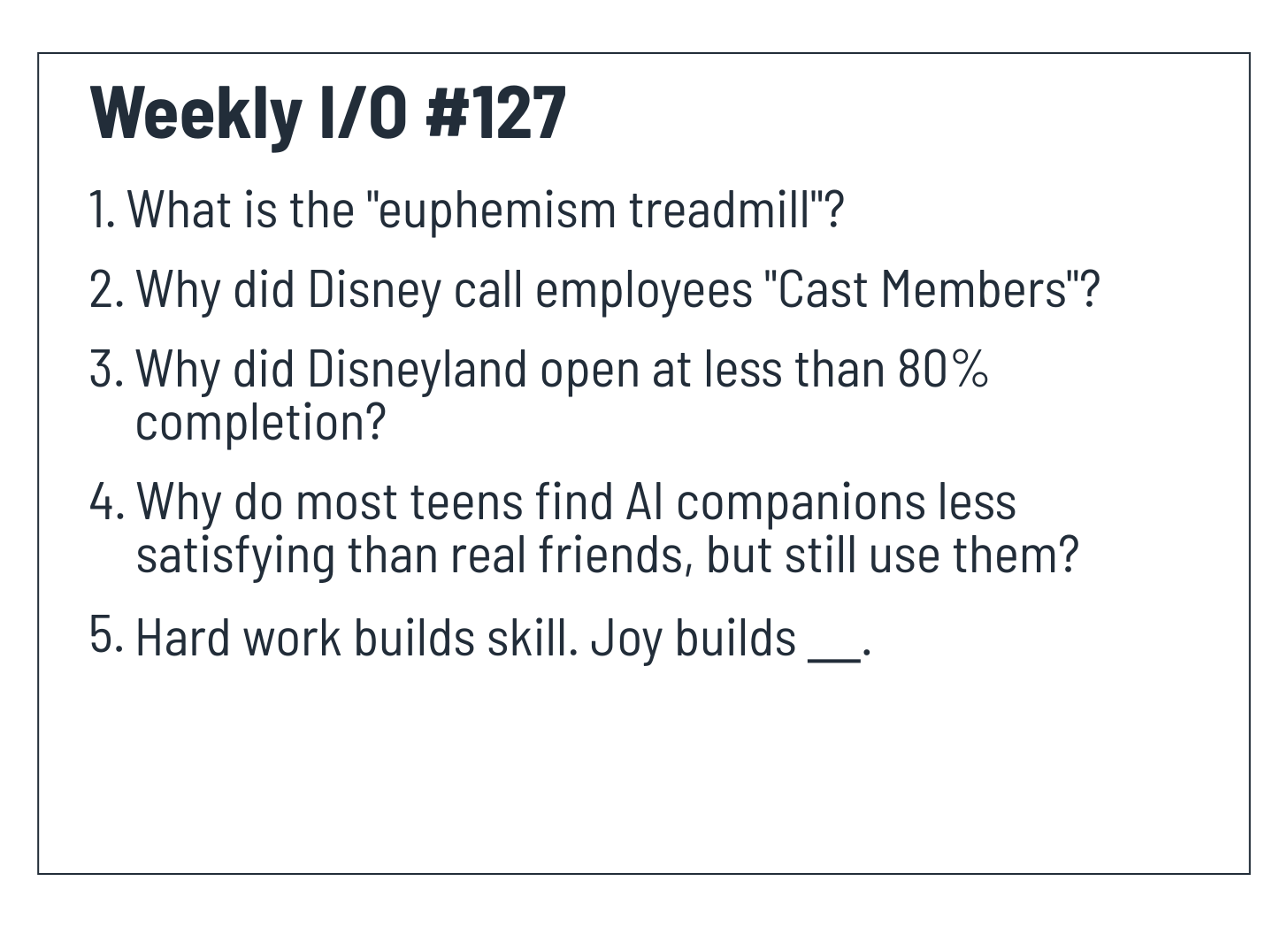
Try answering these five simple questions to review and reinforce what you’ve learned:
Thanks for reading!
One small favor: please share which input you found the most helpful or intriguing! Just comment on Substack with a number!
It only takes 6 seconds to like and comment, while writing each newsletter takes me 6 hours 🫶
And as always, feel free to send me any interesting ideas you came across recently!
Looking forward to learning from you,
Cheng-Wei
Subscribe to Cheng-Wei’s Update | Subscribe to 程維的中文更新 | Subscribe to Weekly I/O | Facebook | Twitter