

Wrong way to put ads in AI, Five Ws communication, Ego-Depletion is Myth
Weekly I/O #126: Discovery Ads for AI, Five Ws Communication, Ego-Depletion is Myth, Four Levels of Agentic Commerce, Humble After Not During

Hey friends,
For this week, two inputs are about future of ads and e-commerce in the AI era.
One about the research on the myth of willpower. And two timeless pieces of advice from Munger and Hemingway.
Happy learning!
Help you absorb better with Forward Testing Effects
Input
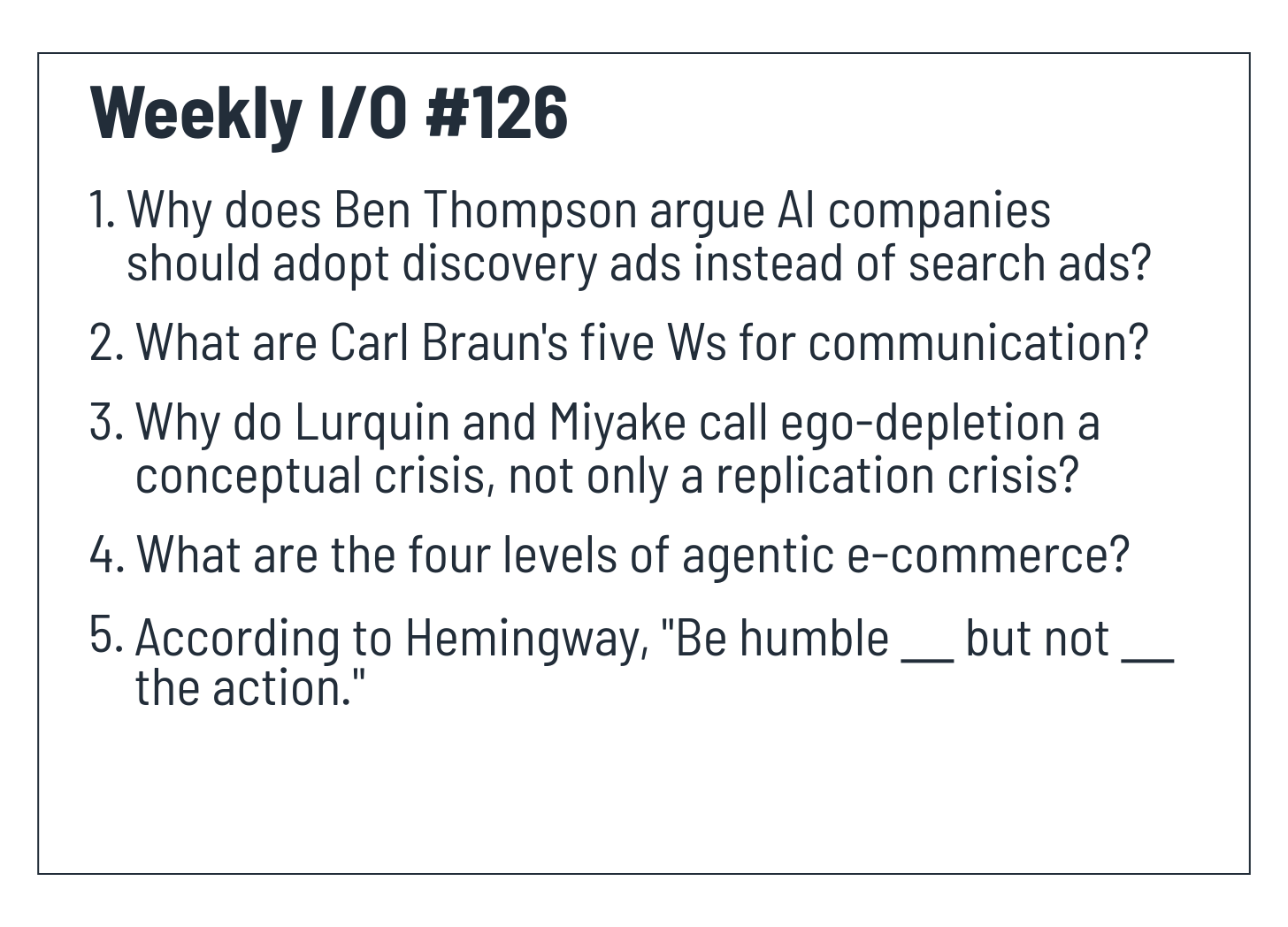
1. AI products like ChatGPT are doing Google-style search ads, but they should learn from Instagram’s discovery model instead. Discovery ads build user profiles to anticipate needs rather than react to what someone just asked, which can create a conflict of interest.
Podcast: Ben Thompson from Stratechery on AI ads, the end of SaaS, and the future of media
How should AI companies make money from ads?
Ben Thompson argues AI platforms like ChatGPT are doing it wrong. Currently, they are experimenting with ads targeted to the context of a user's conversation, much like Google Search ads.
They match ads to the current prompt. It is easier to implement, but it creates two problems:
First, trust: users may doubt whether answers are objective. They will wonder whether the AI shaped its answer to serve the ad.
Second, scale: ad opportunities are limited to narrow prompt contexts. You can only show an ad if the user happens to ask about something an advertiser targets.
The alternative is Meta’s model, like Instagram and Facebook ads. Instead of reacting to what you are doing right now, it builds a profile of your broader interests and shows you products you didn’t know you wanted.
In other words, the strength should be discovery, not intent.
The ideal AI ad model would not wait for you to ask about winter jackets. It would know your interests and the changing seasons and show you the perfect jacket before you even search.
2. The Five Ws: Always tell people who is going to do what, where, when, and why. If you skip the why, people won’t understand, won’t care, and won’t comply.
Book: Poor Charlie’s Almanack
Charlie Munger tells the story of Carl Braun, who built oil refineries on time and on budget.
His rule for all the company’s communications was called the five Ws: You had to tell who was going to do what, where, when, and why.
If you wrote a letter or directive in the company telling somebody to do something and you didn’t tell him why, you could get fired.
In fact, you would get fired if you did it twice.
When you tell people why, they understand it better, consider it more important, and are more likely to comply.
Even if they don’t fully grasp your reason, they are still more likely to follow through.
3. Ego depletion, the idea that willpower is a limited resource, faces a crisis deeper than failed replications. The field cannot even agree on what self-control is or how to measure it.
Paper: Challenges to Ego-Depletion Research Go beyond the Replication Crisis
Is willpower like a battery that can run out? The popular theory of ego depletion says yes.
However, a major replication with 23 labs and over 2,000 participants failed to reproduce the effect.
What’s worse, researchers Lurquin and Miyake argue that the replication failure is only the surface. There are three more conceptual problems beneath.
First, there is no clear definition of self-control. The same task, such as three-digit multiplication, has been used as a self-control task in some studies and as a non-depleting control in others.
Second, the tasks have never been independently validated as measures of self-control. The assumption that all self-control draws on a single shared resource relies on circular logic.
Last, the models are too vague to test. The "strength model" does not specify how resources are consumed. A recent update made it so flexible that it can explain any result. If a model explains everything, it explains nothing.
Therefore, even larger samples cannot save this field because it has not clearly defined what it studies.
This also reminds me of Augustine’s divided will. The experience of conflicting wants is real, but the battery metaphor may not be.
