How to design motivation, Three phases of leadership, Cognitive Load Theory
Weekly I/O #123: Octalysis Motivation Framework, Artful Leadership, Cognitive Load Theory, GPA Decision Styles, One Damn Relatedness After Another
Hey friends,
I’ve been rereading Ted Chiang’s Stories of Your Life and Others recently. It’s always fun to read sci-fi in the midst of so much non-fiction information. Highly recommend!
Anyways, this week is a tour of motivation, decision-making, learning design, and leadership.
Happy learning!
Help you absorb better with Forward Testing Effects
Input
1. Motivation comes from eight core drives: Meaning, Development, Creativity, Ownership, Social influence, Scarcity, Unpredictability, and Loss Avoidance.
Book: Actionable Gamification: Beyond Points, Badges, and Leaderboards
Octalysis is an interesting human-focused framework for understanding how design motivates people. Instead of asking “what feature should we build,” it asks “why would a person want to do anything in the first place?”
It breaks motivation into eight core drives:
Epic meaning and calling: feeling part of something bigger
Development and accomplishment: progress, mastery, challenges (related: Zeigarnik Effect)
Empowerment of creativity and feedback: creating, experimenting, seeing results
Ownership and possession: caring about what you own or build (e.g., the Ikea effect)
Social influence and relatedness: connection, comparison, teamwork
Scarcity and impatience: wanting what is hard to obtain
Unpredictability and curiosity: surprises, mystery, curiosity (related: variable rewards in Hooked model)
Loss and avoidance: avoiding regret or losing progress
Octalysis also splits motivation into two axes:
White Hat vs. Black Hat. White Hat makes people feel fulfilled (meaning, mastery, creativity). Black Hat creates urgency or anxiety (scarcity, uncertainty, loss). The best systems balance both.
Right Brain vs. Left Brain. Right Brain is intrinsic and expressive (creativity, social). Left Brain is extrinsic and analytical (ownership, progress). Both matter, but Right Brain tends to sustain long-term engagement.
A good design does not need all eight. But it should be intentional about which ones it uses.
When I first learned this, I couldn’t help but think about how some of the most intense motivations, like revenge, competition, or even just trying to prove oneself, are involved.
Though not core drives on their own, they are probably behavioral expressions that emerge when certain core drives are activated in specific ways.
2. “The first responsibility of a leader is to define reality. The last is to say thank you. In between the two, the leader must become a servant and a debtor. That sums up the progress of an artful leader.” ― Max DePree
Quote
From the book Leadership Is an Art, Max DePree beautifully sums up the three phases of leadership, from power to stewardship.
First, you need to define reality. Before a leader can inspire or direct, they must provide clarity. This is oftentimes the most challenging part of the job because it requires confronting uncomfortable truths.
Then, in the day-to-day operations of a leader, it flips the traditional hierarchy upside down, making the leader the servant and debtor.
And at the end, it is about recognizing that results are rarely the work of one person.
3. Cognitive Load Theory: Learning fails when working memory is overloaded. Design should protect mental bandwidth.
Article: Cognitive Load Theory
Cognitive Load Theory (CLT) is one of the most well-known frameworks that explains how the brain processes and retains information by managing the limitations of working memory.
It starts from a simple constraint: working memory is limited. If we exceed it, learning slows or stops.
CLT breaks mental effort into three cognitive loads:
Intrinsic load: How easy or difficult the content presented inherently is to learn, which stays relatively constant.
Extraneous load: How easy or difficult it is to learn the content, considering the environment in which it is presented.
Germane load: How much effort is required to apply memory and the intelligence used to make schemas for permanent storage.
It’s perhaps helpful to think of germane load as the result of managing the other two. For example, we reduce Extraneous load specifically to free up mental bandwidth for Germane load.
Intrinsic load is hard to reduce but can be managed. For example, breaking complex ideas into smaller parts and teaching prerequisites first.
Extraneous load is easier to reduce, but still, poor presentation or distractions are everywhere. We should use clean layouts, remove unnecessary steps, and avoid split attention.
We can also increase germane load. For example, we should use worked examples, reflection, and practice that forces sense-making.
4. GPA: Separate decisions into Goal, Priority, and Alternatives, and use a different decision style at each stage.
Podcast: Manus’ Final Interview Before the Acquisition: Oh, the Surreal Odyssey of 2025… - YouTube
Manus co-founder described a GPA decision framework. It splits a decision into three stages:
Goal: decide what we are trying to achieve.
Priority: decide what matters most right now.
Alternatives: generate a wide set of options.
And each stage needs a different decision style.
The goal phase should be autocratic. The leader sets the target so everyone is aligned.
The priority phase should be mixed. The leader decides, but the team provides input and context.
The alternatives phase should be democratic. The team generates options as widely as possible.
Most arguments happen because people are in different stages. For example, someone might be debating the goal while someone else is already picking between options.
The alternatives stage is oftentimes overlooked, but it determines the quality of the outcome. A small option space leads to bad decisions, no matter how smart the team is. A wide option space gives the decision-maker real leverage.
5. “Life is just one damn relatedness after another.” — Julian Huxley
Quote
I read this line from rereading Poor Charlie’s Almanack.
For knowledge, I thought of Wittgenstein’s Family Resemblance. Nothing is defined by a single common essence. Instead, they are all defined by how they are related to each other.
Even in my career, the best work I have ever done has come from connections. Without those connections, I likely would not have had the opportunity to do my best work. (Thank you Cathy and Enid!)
Links
Here’s a list of things I enjoyed learning/relearning this week:
Building Alpha School, and The Future of Education - Colossus
Actionable Gamification: Beyond Points, Badges, and Leaderboards
Manus’ Final Interview Before the Acquisition: Oh, the Surreal Odyssey of 2025…
Gaurav Kapadia on New York City, Investing, and Contemporary Art
Recap
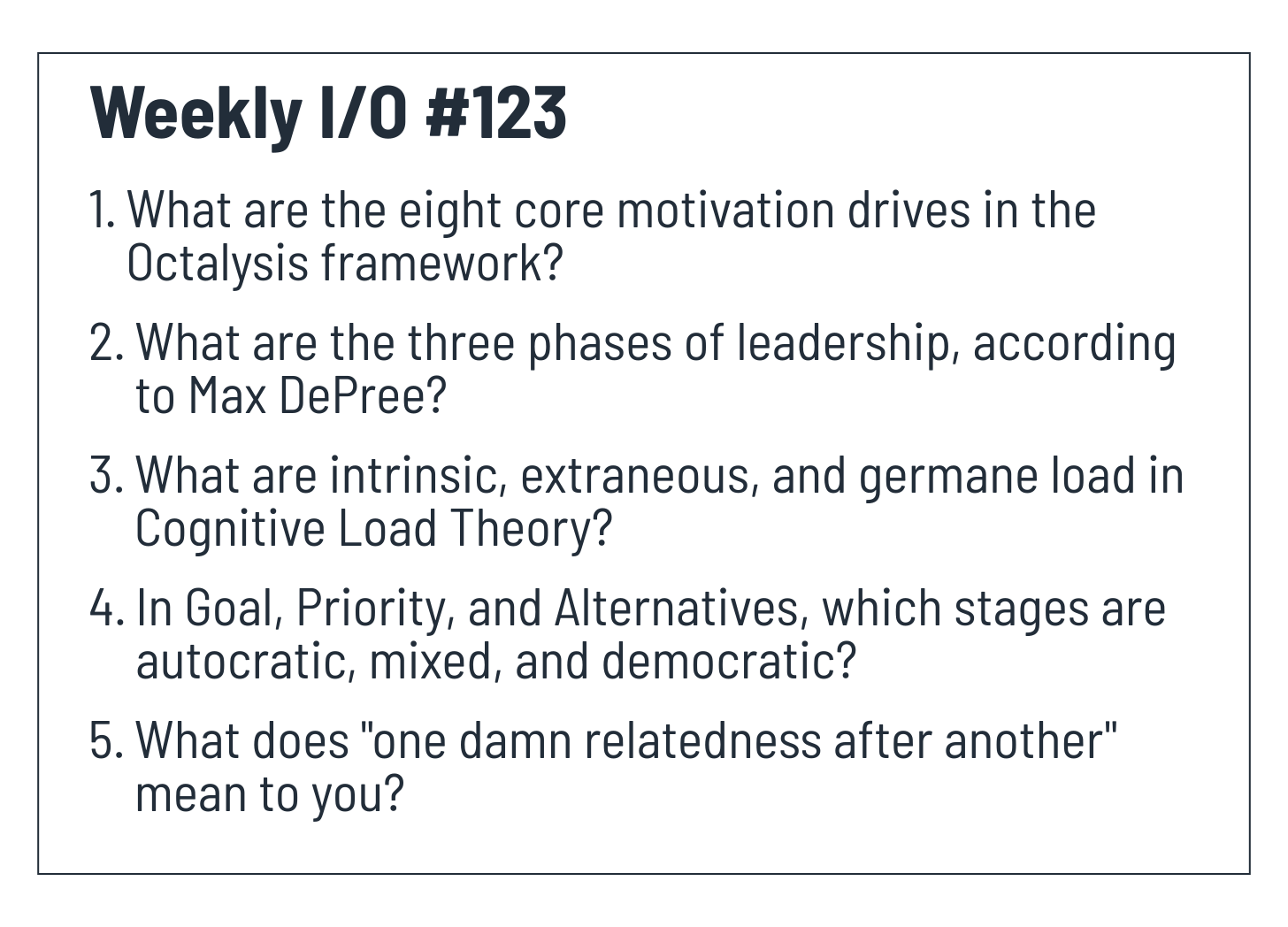
Try answering these five simple questions to review and reinforce what you’ve learned:
Thanks for reading!
One small favor: please share which input you found the most helpful or intriguing! Just comment on Substack with a number!
It only takes 6 seconds to like and comment, while writing each newsletter takes me 6 hours 🫶
And as always, feel free to send me any interesting ideas you came across recently!
Looking forward to learning from you,
Cheng-Wei
Subscribe to Cheng-Wei’s Update | Subscribe to 程維的中文更新 | Subscribe to Weekly I/O | Facebook | Twitter


