

Thinking in two tracks, Seven ways to guarantee misery, Four types of learners
Weekly I/O #122: Munger’s Two-Track Analysis, Kolb’s Four Learning Styles, Prescriptions for Misery, Investment Principles Checklist, Score by How You Play

Hey friends,
As the year came to an end, I decided to reread one of the books I return to most often: Poor Charlie’s Almanack. I first read it when I didn’t even know how to write in English :)
Having read it many times, I still learned a lot from it. It also made me reflect deeply on the decisions I made in 2025.
Rereading it is like having an old, wise man keep telling me, “I told you so.” I guess we just always need to be reminded time and again.
Anyways, you can also read it for free here on Stripe Press. Recommend to you.
Happy holidays!
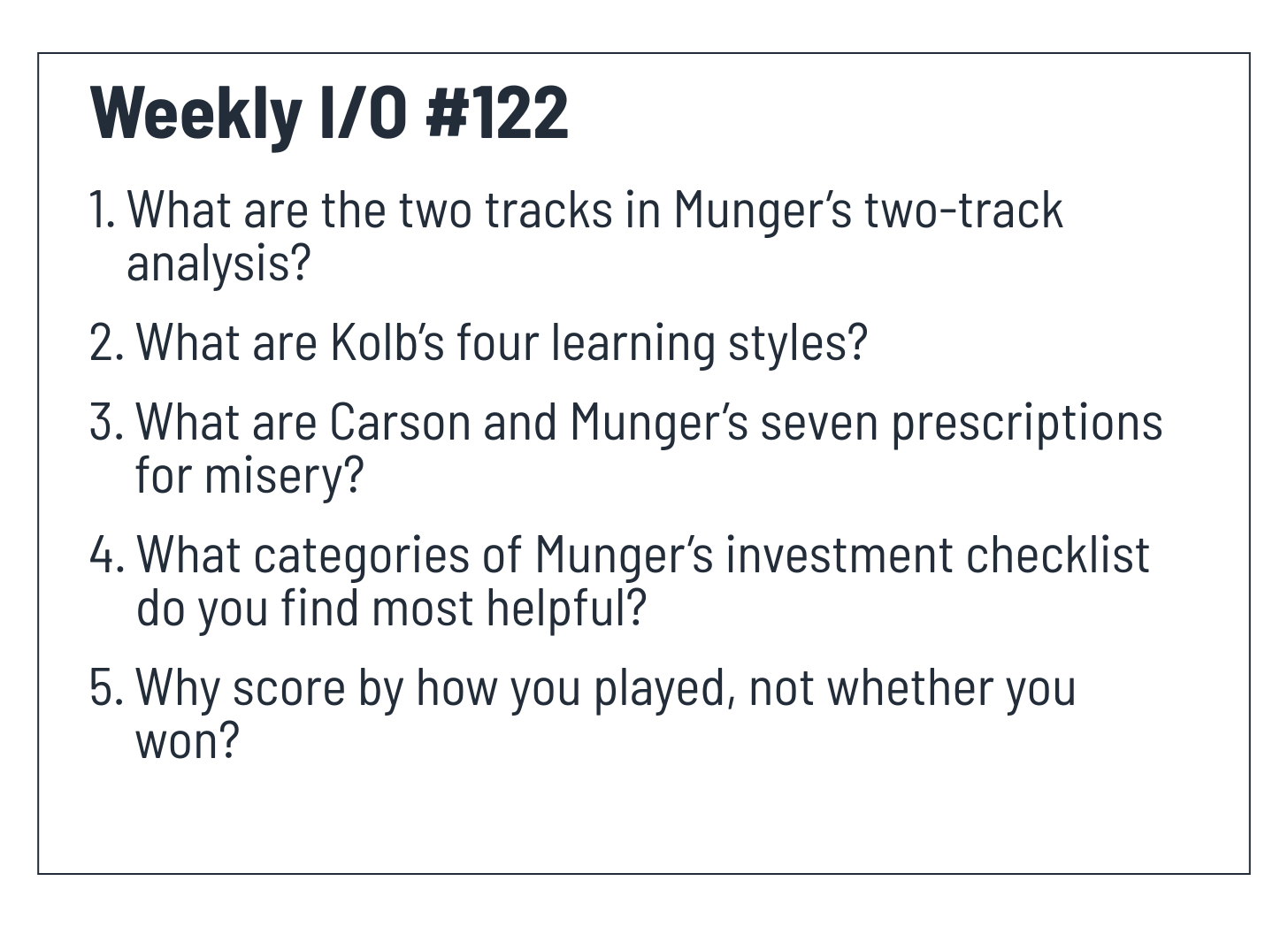
Help you absorb better with Forward Testing Effects
Input
1. Two-Track Analysis: Examine both rational factors and psychological biases when making decisions. Munger identified 25 tendencies that distort our thinking.
Book: Poor Charlie’s Almanack (Stripe Press edition)
How do you make better decisions? Charlie Munger uses what he calls “two-track analysis.”
The first track is rationality: what do the facts say? You work out the problem like an engineer: calculating actual probabilities and weighing the evidence objectively.
The second track is psychology: what biases might be distorting your judgment? Munger identifies the subconscious influences where the brain automatically does things that are generally useful but often malfunction.
Munger identified 25 tendencies that he used as a checklist when making decisions:
Reward- and punishment-superresponse tendency
Liking/loving tendency
Disliking/hating tendency
Doubt-avoidance tendency
Inconsistency-avoidance tendency
Curiosity tendency
Kantian fairness tendency
Envy/jealousy tendency
Reciprocation tendency
Influence-from-mere-association tendency
Simple, pain-avoiding psychological denial
Excessive self-regard tendency
Overoptimism tendency
Deprival-superreaction tendency
Social-proof tendency
Contrast-misreaction tendency
Stress-influence tendency
Availability-misweighing tendency
Use-it-or-lose-it tendency
Drug-misinfluence tendency
Senescence-misinfluence tendency
Authority-misinfluence tendency
Twaddle tendency
Reason-respecting tendency
Lollapalooza tendency
You can read more details on each tendency here: Talk Eleven.
2. Seven prescriptions for guaranteed misery: Ingest chemicals to alter mood, harbor envy and resentment, be unreliable, learn only from your own experience, stay down after setbacks, and ignore the power of inversion.
Book: Poor Charlie’s Almanack
Johnny Carson once gave a commencement speech where he said he couldn’t tell graduates how to be happy, but he could tell them from personal experience how to guarantee misery.
Carson’s three prescriptions for sure misery:
Ingesting chemicals in an effort to alter mood or perception
Envy
Resentment
Charlie Munger added four more prescriptions:
Be unreliable. Do not faithfully do what you have engaged to do. Master this habit, and you will be distrusted and excluded from the best human contributions and companies.
Learn everything from your own experience. Minimize what you learn vicariously from the good and bad experiences of others, living and dead. This prescription is a guarantee for misery and mediocrity.
Go down and stay down when you get your first, second, or third severe reverse in the battle of life. Because there is so much adversity out there, even for the lucky and wise, this will guarantee that you will be permanently trapped in misery.
Ignore the saying, “I wish I knew where I was going to die, and then I’d never go there.” If you want fuzzy thinking and infelicity, discount this method of thinking backward from what you want to avoid.
Munger’s prescriptions work because they compound. Unreliability destroys trust over time. Learning only from personal experience limits your sample size to one lifetime. Staying down after setbacks prevents the recovery that naturally follows persistence.
And inversion, thinking about what to avoid, is perhaps Munger’s most powerful mental model. Instead of asking “How do I succeed?”, ask “What would guarantee failure?” Then avoid those things.
You can read the whole talk here: Talk One.
3. Kolb’s Four Learning Styles: People learn differently based on how they approach tasks (doing vs. watching) and how they process experiences (thinking vs. feeling). These create four types: Diverging, Assimilating, Converging, and Accommodating.
Paper: Learning Styles and Disciplinary Differences
Last week, we explored Kolb’s Experiential Learning Cycle, the four-stage loop of Concrete Experience, Reflective Observation, Abstract Conceptualization, and Active Experimentation.
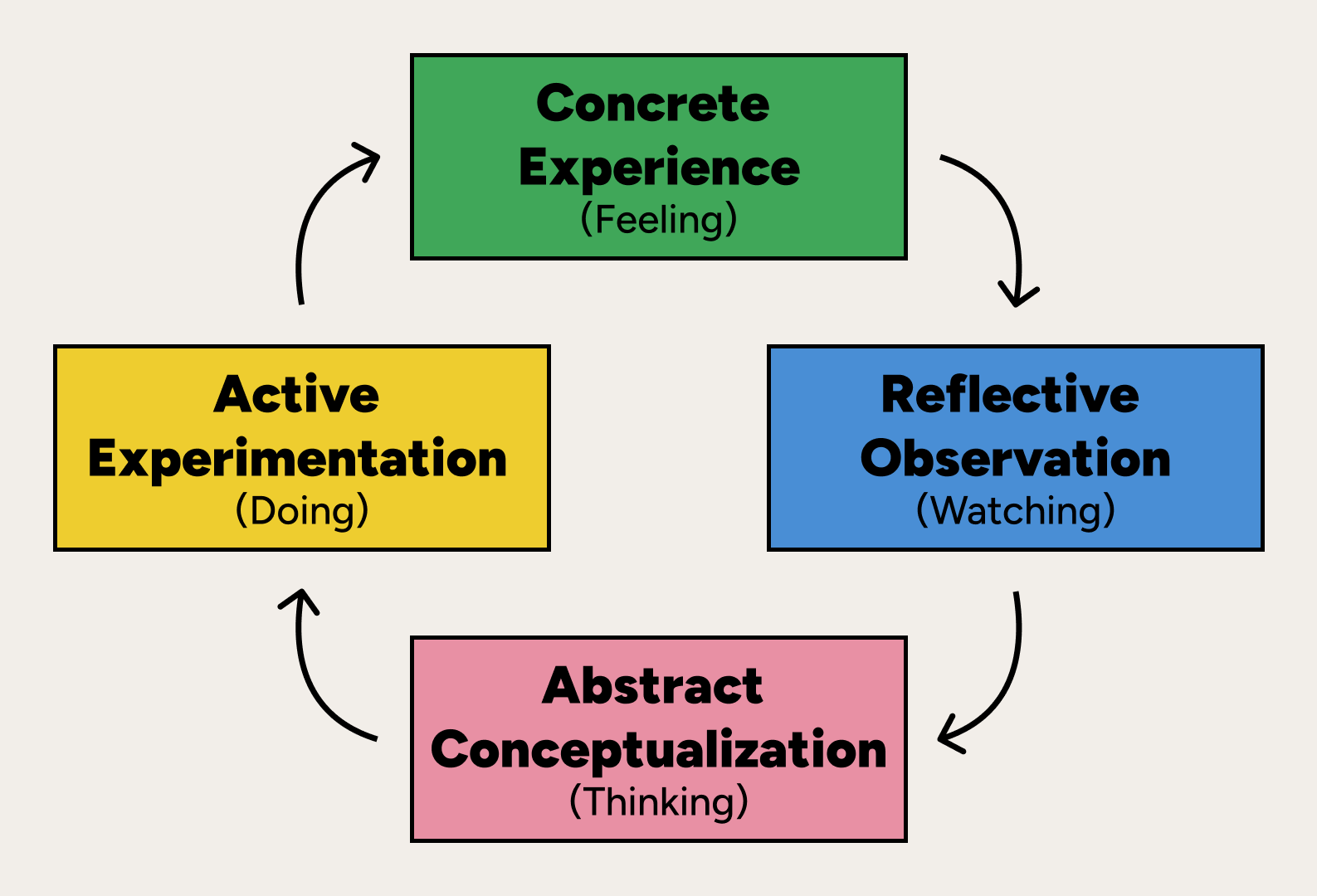
But Kolb’s theory goes further. He also identified that people have different preferences within this cycle.
These preferences emerge from two dimensions.
Processing: how you approach a task. Do you prefer doing (Active Experimentation) or watching (Reflective Observation)?
Perception: how you respond. Do you lean toward thinking (Abstract Conceptualization) or feeling (Concrete Experience)?
These create four styles:
Diverging (Feeling + Watching): Imaginative brainstormers who see multiple perspectives. The creative who generates ideas.
Assimilating (Thinking + Watching): Logical planners who organize information into theories. The architect of coherent plans.
Converging (Thinking + Doing): Practical problem-solvers who find uses for ideas. The engineer who makes things work.
Accommodating (Feeling + Doing): Hands-on executors who rely on intuition. The builder who learns by trial and error.
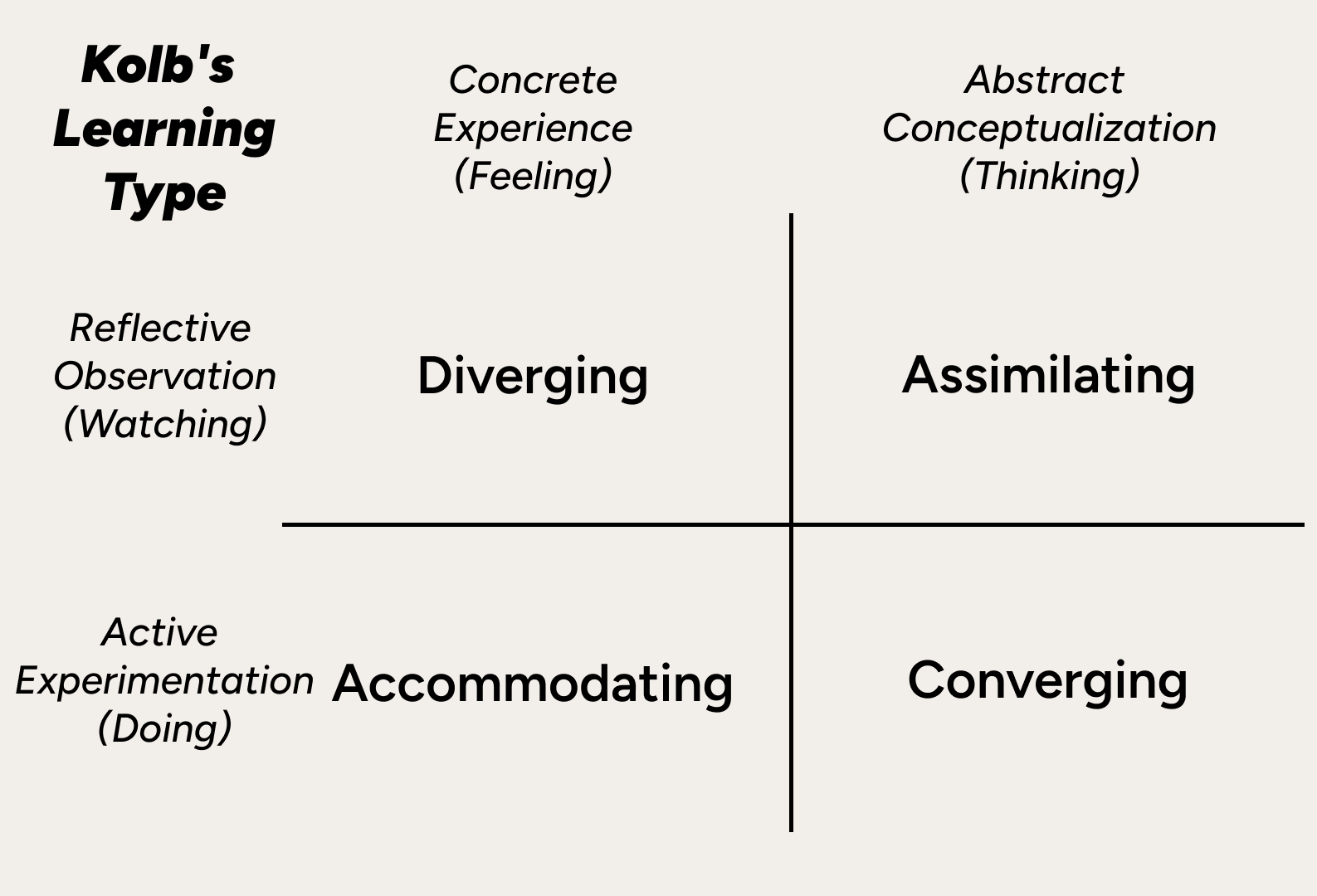
No one fits neatly into just one style. Effective learning engages all four. This also explains why diverse teams outperform homogeneous ones.
Two related past inputs: Learning Style Myth and Bartle Taxonomy of Player Types.
4. Munger’s Investment Checklist: Great investing follows principles in nine categories: Risk, Independence, Preparation, Rigor, Allocation, Patience, Decisiveness, Change, and Focus.
Book: Poor Charlie’s Almanack (Stripe Press edition)
Checklists minimize errors. Munger organizes his investment principles into nine themes:
Risk: Start by measuring risk, especially reputational. Avoid questionable characters. Shun permanent loss.
Independence: Just because others agree or disagree doesn’t make you right or wrong. Only the correctness of your analysis matters.
Preparation: The only way to win is to work, work, work, and hope for a few insights. The will to prepare beats the will to win.
Analytic Rigor: Determine value apart from price, progress apart from activity. Invert, always invert.
