

Learning Loops, Why confusion helps you learn, Content test
Weekly I/O #121: Kolb’s Experiential Learning Cycle, Epistemic Emotions, Entertain or Inspire or Educate, Cognitive Conflict and Aha Moments, Discipline Eliminates Inspiration as Bottleneck

Hey friends,
I took a late Thanksgiving break last week. This week, we are exploring ideas around learning design and content creation. Thanks again to Ying-Jui Tseng for the topics on learning design.
Happy learning!
Help you absorb better with Forward Testing Effects
Input
1. Kolb’s Experiential Learning Cycle: Effective learning follows a four-stage loop of Concrete Experience, Reflective Observation, Abstract Conceptualization, and Active Experimentation. Most traditional teaching skips straight to concepts, missing the experience that makes learning stick.
Article: Kolb’s Learning Styles & Experiential Learning Cycle
Why do we forget most lectures but remember lessons learned the hard way?
David Kolb‘s Experiential Learning Theory, published in 1984, explains that effective learning isn’t just receiving information. It’s a cycle with four stages:
Concrete Experience (Feeling). You try something. You attempt a task, encounter a problem, or engage directly with a new situation. This is the raw material of learning.
Reflective Observation (Watching). You step back and think about what just happened. What worked? What didn’t? What surprised you?
Abstract Conceptualization (Thinking). You extract principles from your reflection. You form theories, identify patterns, and create mental models that explain your experience.
Active Experimentation (Doing). You take your new understanding and test it in a different situation. This generates new concrete experiences, and the cycle continues.
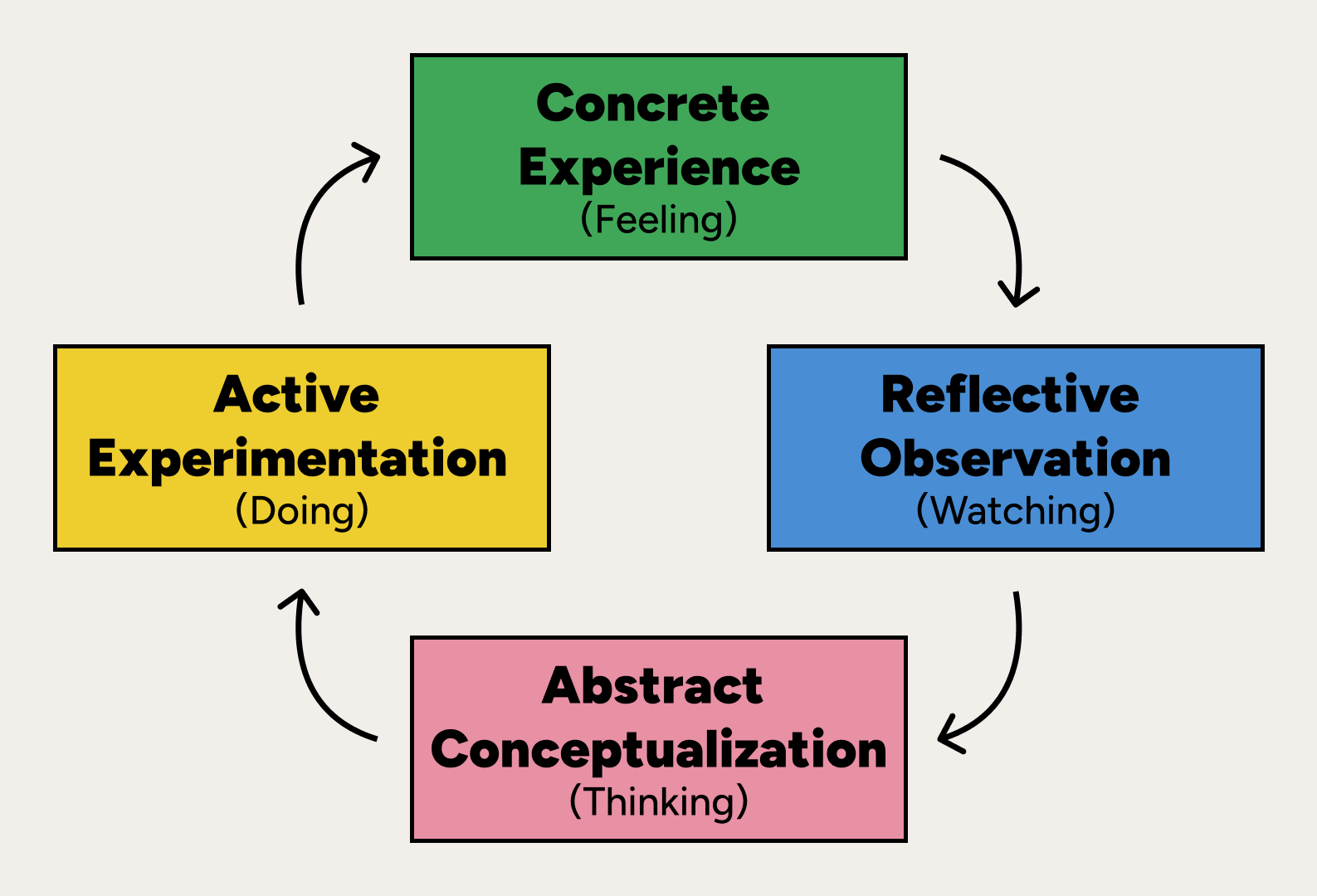
But there’s a problem with most education: it starts at stage three. Teachers jump straight to “here’s the concept” and “here’s what the research says.” Students receive abstract principles without the concrete experience that would make those principles meaningful.
Therefore, experiential learning flips this. Do first. Reflect. Then abstract. Then do it again. This is why hands-on training beats lectures. Case studies beat textbook definitions. The experience creates a hook for the concept.
This is closely related to the CCAF Instructional Design Model (Context, Challenge, Activity, and Feedback) and Bloom’s Taxonomy.
After learning this, I’m reflecting on how Weekly I/O can incorporate these principles for readers. Stay tuned! If you are a paid subscriber, you will soon be able to try something I’m currently building!
2. Learning that lasts requires cognitive conflict. When existing beliefs clash with new evidence, the discomfort forces you to update your mental model. Without this conflict, there’s no motivation to change how you think.
Paper: On the cognitive conflict as an instructional strategy for conceptual change
Without friction, there is no reason to change what you think. Cognitive conflict creates that friction. When you expect one outcome and reality delivers another, your mind must reconcile the gap.
This process of reconciling leads to the Aha moment in learning: the sudden collapse of your old mental model and the birth of a new one.
The emotional peak from this Aha moment marks the memory and motivates you to keep going.
So, for learning design, a simple sequence can be:
Surface the learner’s intuition.
Ask for a clear prediction or choice.
Reveal a result that is explainable yet counter to that prediction.
Name the conflict so it becomes conscious.
Offer the new principle that resolves it.
Let the learner apply it right away in a fresh scenario.
In this sequence, learning goes beyond simply acquiring information. It becomes active model-building (like Programming as Theory Building), fueled by cognitive conflict.
3. Entertain, Inspire, or Educate, Simply: Every message must make people laugh, learn, or feel motivated to act. And it must do so without requiring explanation.
Podcast: Inside Tech’s Water Cooler: Breaking Down the Magic Behind TBPN with John Coogan & Jordi Hays
To make a piece of content widespread, it should be filtered through three questions about its audience: Did they laugh? Did they learn something? Did they feel motivated? At least one must be true.
In Jordi Hays‘ words:
