

What's good feedback, Gaps in the four theories, Four types of feedback
Weekly I/O #114: Three feedback questions, Gaps in Fabric of Reality, Four types of feedback, Feedback to Teacher, Bad Luck Saves Worse Luck

Hey friends,
Here's your weekly dose of inputs and outputs. Happy learning!
Help you absorb better with Forward Testing Effects
Input
Here's a list of what I learned this week.
1. Good feedback should answer three questions: Where am I going, how am I going, and where to next. Effective feedback guides learning by clarifying goals (feed up), tracking progress(feed back), and planning future steps (feed forward).
Paper: The Power of Feedback - John Hattie, Helen Timperley, 2007
What makes feedback effective in our learning journey? In their 2007 paper, John Hattie and Helen Timperley state that feedback only drives learning if it answers three questions: Where am I going, how am I going, and where to next.
Asking "Where am I going?" sets the direction. What are the goals? Students need clear goals and success criteria, not vague statements. If the goal is to build suspense in writing, feedback about spelling is unhelpful.
Asking "how am I going?" helps students reflect on progress. What progress is being made toward the goal? They need to know how their current performance compares to past efforts or expectations. For instance, a student may find it motivating to learn that their essay now uses stronger transitions than before.
Asking "where to next?" builds momentum. What activities need to be undertaken to make better progress? Learners want to know what to try next, not just whether they succeeded or failed. Effective feedback suggests the next challenges, strategies, or adjustments to make.
These questions correspond to notions of feed up, feed back, and feed forward. When feedback connects these three components, it helps close the gap between current ability and desired learning.
These three questions help complement the CCAF Instructional Design Model.
2. Deutsch's four strands (quantum physics, evolution, theory of computation, and epistemology) each, on its own, feels cold and incomplete. But together, they form a coherent picture of reality, as each strand fills the gaps of the others.
Book: The Fabric of Reality
In Four-strand Theory of Everything, we introduced how David Deutsch proposes reality is a fabric woven from four strands: quantum physics, evolution, theory of computation, and Popperian epistemology.
However, Deutsch acknowledged that each strand looks bleak and incomplete in isolation.
Quantum theory provides accurate numbers in theory but seems random and feels like chaos.
Evolution explains adaptation but looks purposeless as life is just blind selection.
Computation defines limits but appears as abstract mathematics detached from the material world.
Popper shows how knowledge grows through error correction but never grants certainty.
In Deutsch's view, each strand fills one another's gaps.
For example, quantum physics plus computation gives quantum computing. Deutsch argues that this computing is a physical process carried out across many branches of reality, and the final result comes from their interference.
This connection fills the explanatory gap: computation becomes a physical process embedded in the multiverse, and quantum mechanics is no longer a random mystery but a structured information flow.
Another example, evolution plus epistemology reframes ideas as populations. Knowledge growth itself can be seen as an evolutionary process. Just as species survive by adapting, ideas survive by resisting criticism.
This fills another gap: epistemology gains a biological grounding, while evolution is revealed as a general process that applies not just to organisms but also to culture and science.
Alone, each strand feels thin and leaves gaps. Together they form a single coherent picture of reality.
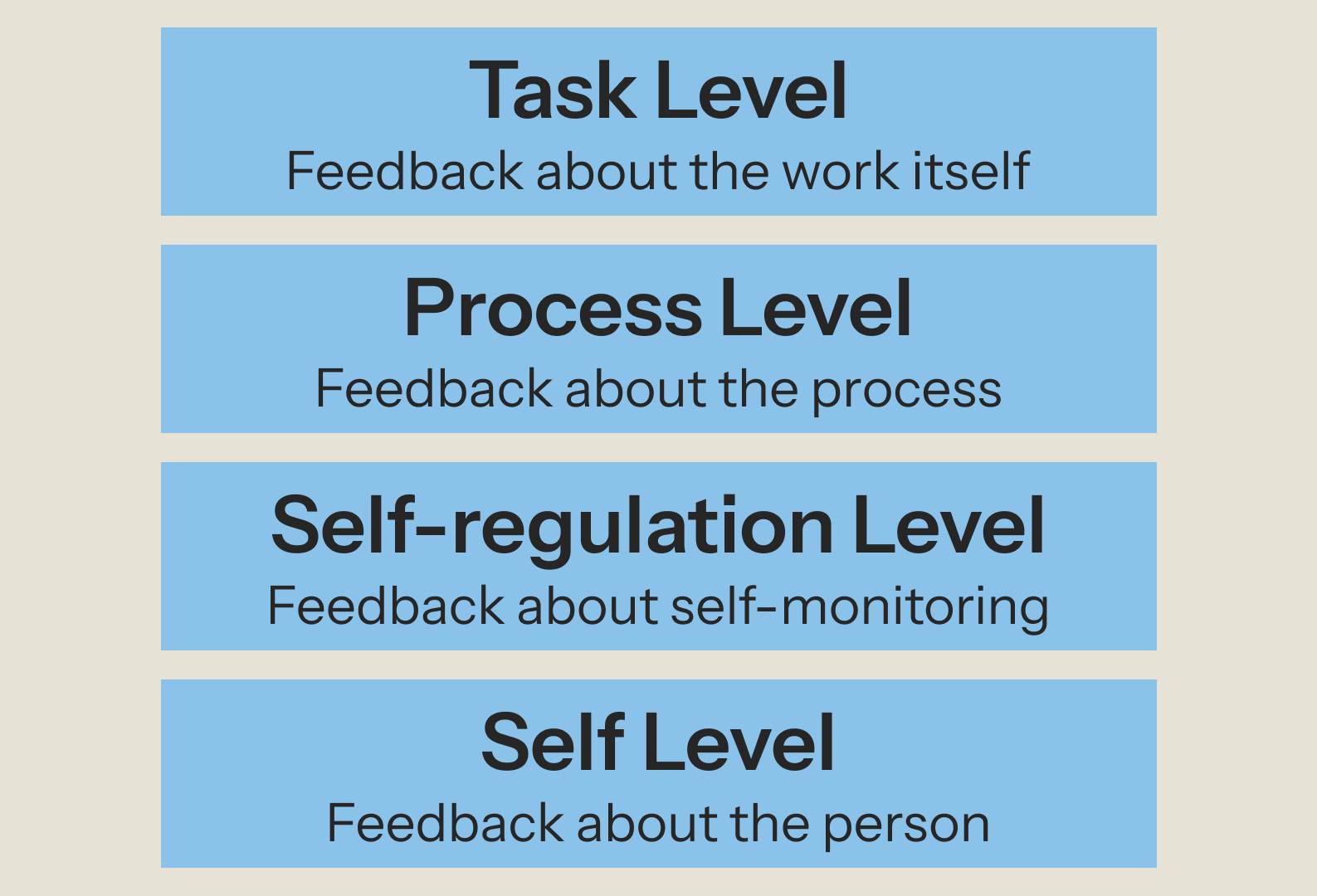
3. Feedback falls into four types: task, process, self-regulation, and self. The closer the feedback is to the work itself, the stronger its effect. Therefore, self-feedback is usually least useful for learning outcomes.
Paper: The Power of Feedback - John Hattie, Helen Timperley, 2007
Not all feedback helps students in the same way. John Hattie and Helen Timperley proposed four levels of feedback, each with different effects on learning.
The first level is task feedback. This is information about correctness. For example, a teacher might say, "You need to include more detail about the WW2." for a writing assignment. Task feedback helps students fix mistakes, but often stays tied to the specific question. It is powerful when it points out errors in interpretation, but it rarely transfers to new problems. It explains why skills like poker are hard to transfer in other domain.
The second level is process feedback. Here, the teacher draws attention to strategies and approaches. For instance, "This essay may make more sense if you use the structure we practiced." This kind of feedback pushes students to think about how they are working, not just what they produced.
The third level is self-regulation feedback. This helps students monitor their own progress, build confidence, and develop habits of checking their work. An example might be, "You already know the features of a strong introduction. Check if your first paragraph includes them." This feedback improves self-efficacy and supports autonomy.
The last level is self feedback. Statements like "You are smart" or "Good job" focus on the person rather than the work. Praise of this type feels nice but adds little to learning. Studies show it rarely leads to real improvement because it carries little information that provides answers to any of the three questions good feedback should be able to answer (Where am I going, how am I going, and where to next).
The most effective pattern is to guide students from task feedback to process and then to self-regulation. This sequence helps them not only correct errors but also grow into independent learners.
4. Student-to-teacher feedback drives compounding gains in learning because when teachers know how their teaching is landing and adjust, the effects ripple back to students. Same with learning software.
Paper: Visible Learning: A Synthesis of Over 800 Meta-Analyses Relating to Achievement
